Resources from Sunday

Praise the Lord for a great day of teaching and fellowship at the chapel! In the morning we looked at a robust basis for true unity amongst the churches. In the afternoon we had pleasant weather for our Tortworth Lake walk and tea and were blessed to have Rev. Maurice Wheatley with us in the evening when he spoke on providence. It was great to have so many family members and guests along with us too!

Further to the our sermon from Amos 3:3 (“How can two walk together unless they are agreed”) here are a couple helpful articles if you would like to pursue the topic further.

Our FIEC Gospel Unity Statement can be found here.

On the subject of theological triage you can find a helpful article by Albert Mohler Jr. here.

Another helpful model comes from the ESV Study Bible (2008), pp. 2506-07. I summarize it here. Similar to the model of theological triage is one of a target, or concentric circles. We are to aim to hit the mark in the middle, not straying from orthodox belief. That said we must recognize that not all doctrines have the same significance and affect how we relate to others who profess to be a believer or who truly are.  We need to ask ourselves the question, “on which hill are we willing to die.” Let us not confuse the periphery for the centre.

concentric circles

The relative importance of theological issues can fall within four categories: absolutes or the core beliefs of Christianity, convictions or those beliefs which are so important have a significant impact of the health and effectiveness of the Church, opinions or items that are less clear and certainly not worth dividing over, and questions or unsettled items to which answers would not necessarily effect or alter the absolute tenants of the Faith.

To help one discern where a theological or practical issues falls within the circle one can weigh the cumulative force of the following seven considerations: 1) relevance to the character of God; 2) biblical clarity; 3) relevance to the essence of the gospel; 4) biblical frequency and significance; 5) effects on other doctrines; 6) consensus among Christians; and 7) effect on personal and Church life. These need to be understood collectively. Often only one of these seven tools is used which produces a skewed result and a person or tribe resting upon an absolute that is actually an opinion (or visa versa). “The ability to rightly discern the difference between core doctrines and legitimately disputable matters will keep the Church from either compromising important truth or needlessly dividing over peripheral issues.”

The Lord’s Sweetest Blessings,

Pastor Chris

Faulty Thinking

This summer we have been blessed by our mid-week studies on William Wilberforce’s book Real Christianity (modern paraphrase version, 2006). The book seeks to contrast the differences between authentic Christianity or nominal and cultural Christianity to a) help believer’s better understand their faith and share it with others and b) show nominal Christians the faulty thinking behind their own claims and so lead them to Christ. Some areas of such faulty thinking we have investigated surrounds works vs. grace righteousness, the fallen nature of humanity, the presence of evil, and human vs. divine wisdom and authority. At its heart each of these topics comes back to how we view Scripture. Proverbs 3:5-8 says:

Trust in the Lord with all your heart,
    and do not lean on your own understanding.
In all your ways acknowledge him,
    and he will make straight your paths.
Be not wise in your own eyes;
    fear the Lord, and turn away from evil.
It will be healing to your flesh
    and refreshment to your bones.

While nominal Christianity still proves a issue, a matter we have often discussed that is both associated with it but different from it is modernist or liberal Protestantism. On this matter this chasm could not be wider between the option of truth and falsehood. Which will you choose? In only one will you find life and life to the full (Jn 10:10):

chasm[image from an unknown American newspaper circa. 1920s]

Gratefulness for the Gospel

Paul opens his letter to the Colossians with a thanksgiving prayer for two things: the Gospel and the believers in Colossae. Often even true Christians can lose their passion or gratefulness for the Gospel, and yet this ought to be the mainstay that undergirds our Christian sense of joy, mission and piety. Can we honestly say with Paul that we continually praise the Lord for His Gospel of grace and His saving work in our life? We should. Paul reminds us of the dire circumstances from which we were saved from and the gratefulness this should produce. In vv. 13-14 he writes, “He has delivered us from the domain of darkness and transferred us to the Kingdom of His beloved Son, in whom we have redemption, the forgiveness of sins.” Sweet redemption! Do you remember your first love? The knowledge of what Christ did for us and how much we continually need Him should bring us to our knees with thanksgiving, great joy and humility, “giving thanks to the Father, who has qualified you to share in the inheritance of the saints of light” (Col 1:12 ESV). One helpful exercise to cultivate such thankfulness and praise for the Gospel is to remember how we were brought to faith in Christ. We often call this our testimony.[1]

So get out a pen and paper, or sit down at your computer, and begin to write out your testimony (we’ll limit this to our conversion experience for in the broadest sense this can apply to ALL that the Lord has done in our life). This will serve to bring God’s incredible grace to mind not only to increase our thanks but also to help refine your knowledge of His work in your life so you can more readily share the Gospel with others.

I share my own condensed testimony with you here, not to boast, but as an example, recognizing our stories will all be as unique as we are but also with a strong commonality as we are all saved by the same Lord:

“I was born and raised in a nominal Christian family. Though my parents were nominal, or cultural Christians, that did not stop me from being influenced in a positive way towards the Gospel. Many folks consider it a privilege to be led to Christ through some type of “Damascus road experience” after having blatantly pursued an outward life of sin, and can pinpoint their conversion to a precise day, hour and second. Certainly such conversions are powerful witnesses and testimonies to God’s grace and work in the world, however, this was not my experience. For me the transition appeared as much more progressive.

In the parable about of the vineyard workers (Matt 20) these ‘Damascus road conversions’ could be considered those hired at 5 o’clock. Responding to God’s providential care at a young age I was a worker called at the 9th hour. Though the attitude of the early workers is portrayed negatively, in practicality it is a blessing to be called early and it is a privilege to know Christ from a young age and have longer to get to know Him. I count it as God’s wonderful grace that I was positioned in a place where I could respond to the Gospel early in life and have the opportunity to share in His work and experience His blessings. In fact, I can never remember not knowing the Lord’s presence in my life and count that all grace (Ps 22:10b). Through the Lord’s love He surrounded me with believers, a Biblical church and solid mentors whom the Holy Spirit used to lead me into a lifesaving relationship with Jesus. In 1995 I publically professed my faith in Christ for the forgiveness of my sins and was baptized. During my childhood I was kept from certain outward forms of sin which other youth succumbed to. While not perfect, the Lord kept me close to Him and built me up in the most holy faith and gave me a desire to delight in and follow Him, something which I have done ever since. As I have matured in my faith I have grown in my awareness of my own sin and the sin of this world and the need for a Saviour. This, and the knowledge of grace, continues to produce the fruit of humility as I declare, ‘I am a great sinner, but Christ is a great Saviour,’ who working through me, can do immeasurably more than I could ever hope or accomplish, for His glory. Amen.”

May our testimonies increase our grateful praise and humility!

The Lord’s Sweetest Blessings,

Pastor Chris

[1] Upon reflection, if you discover there is no proof that you have ever responded to Christ, hence why v.12 makes little sense to you, would you respond to the Gospel today?

Chapel Upgrades

20150720_135106[1] 20150720_151503 20150720_144954

Thus says the LORD of hosts: Consider your ways. Go up to the hills and bring wood and build the house, that I may take pleasure in it and that I may be glorified, says the LORD. You looked for much, and behold, it came to little. And when you brought it home, I blew it away. Why? Declares the LORD of hosts. Because of my house that lies in ruins, while each of you busies himself with his own house. (Haggai 1:7-9 ESV)

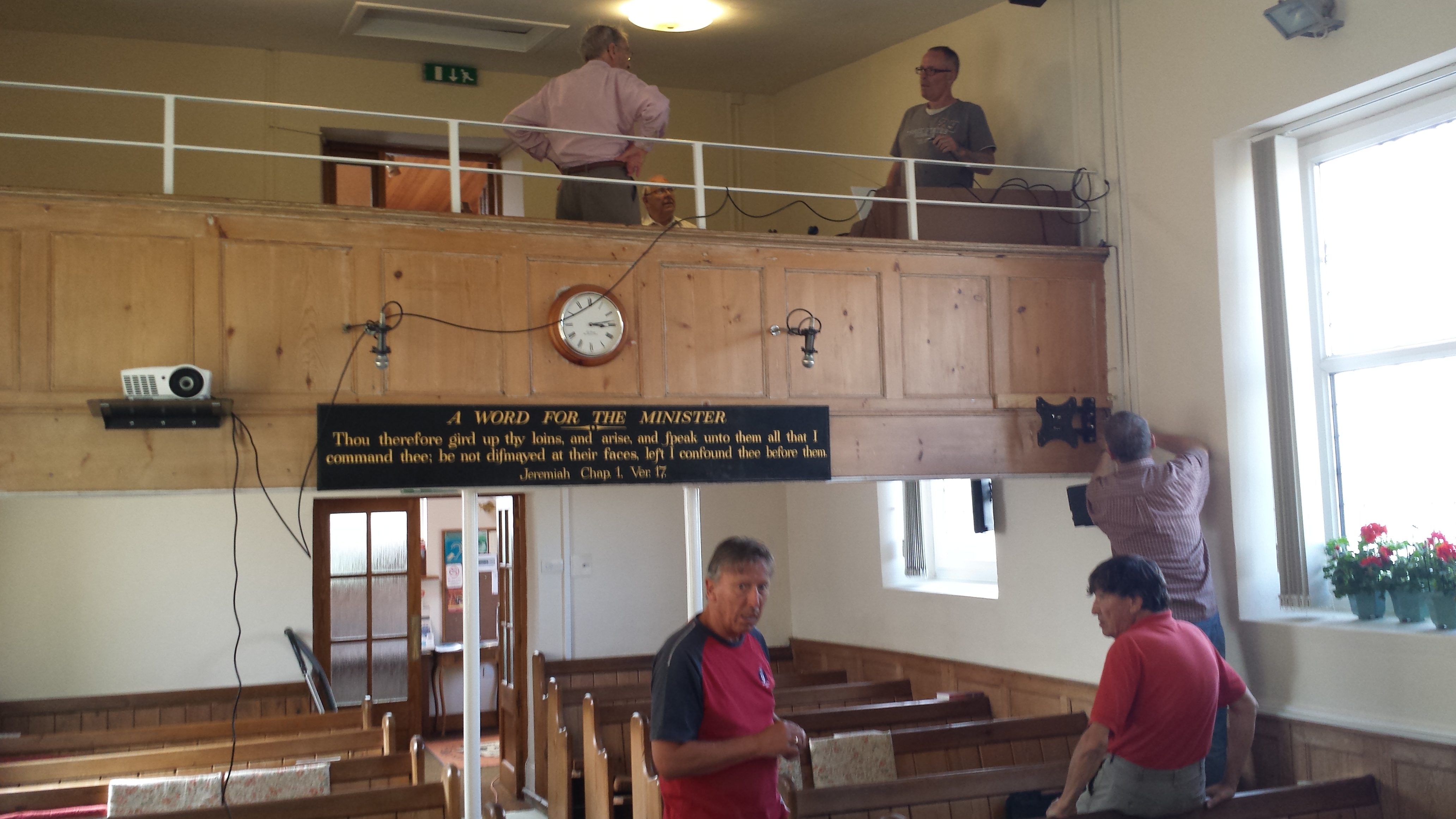
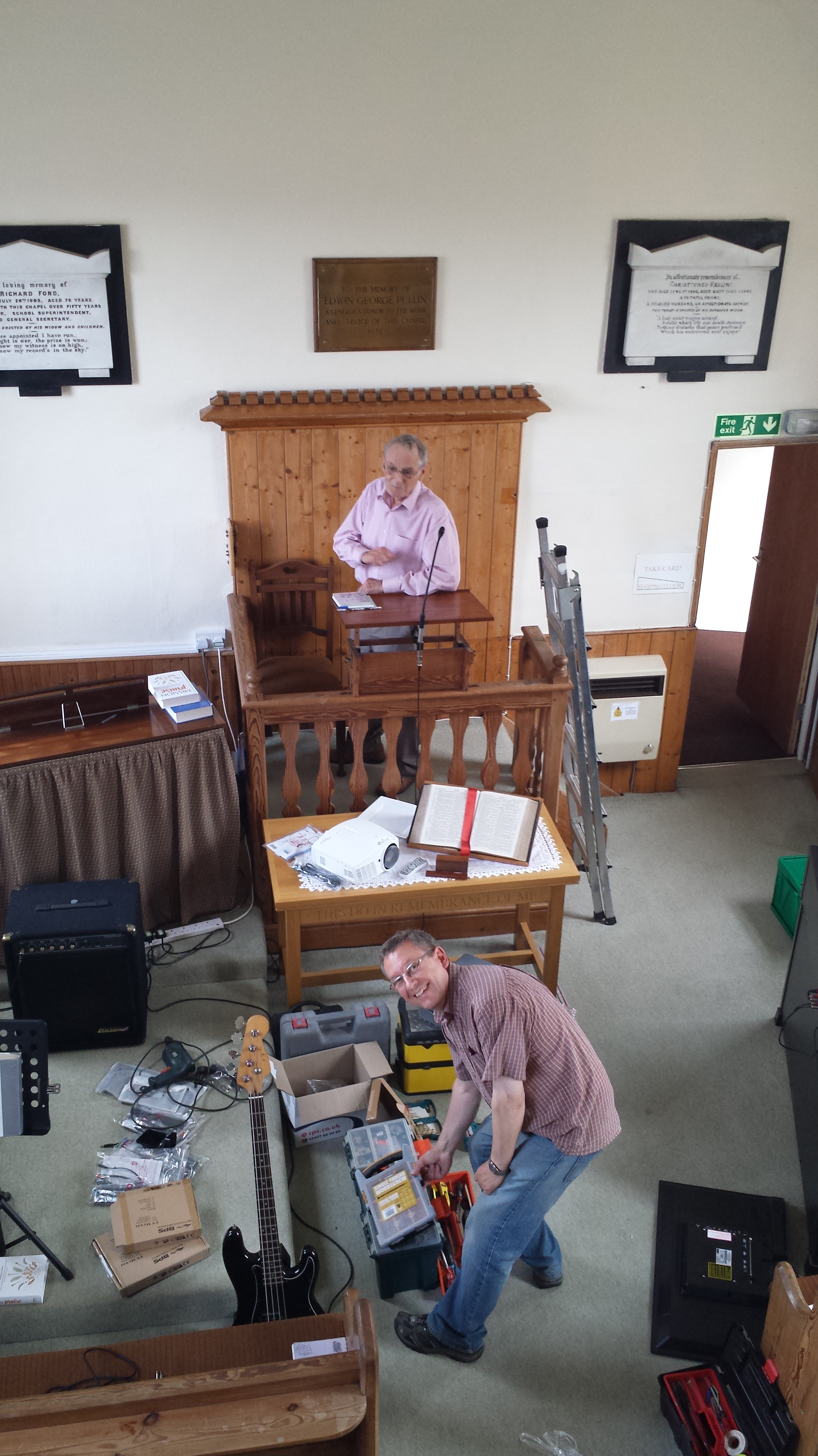
This afternoon a number of men from the chapel came out for a work-bee to install phase I of our chapel upgrades this summer (thanks guys!). These included audio-visual upgrades (a new lap-top, projector, monitors and sound upgrades) and phase II will be the replacement of historic plaques at the front of the chapel to the rear to make space for the projector to project upon, as well as the placement of a cross.

As a local Christian fellowship we believe that the meeting house, chapel, church or whatever one calls the physical place where worship and ministry centre around, is not the Church but merely facilitates its life. The Church is the community of the redeemed in Christ both local and universal. The chapel building, like our new audio-visual upgrades, is only a tool to facilitate local ministry. We are grateful for this building entrusted to us and seek to maintain it in such a way as to glorify God. Bearing in mind that our chapel is not “the Temple” and what has been said above, we desire to ensure our chapel is ship shape and Bristol fashion for the following reasons:

  1. So passersby’s or visitors will see the glory of God because this buildings is cared for in such a way as to magnify the Lord and be useful for His service;
  2. So people will know that our God is not a shoddy God but worthy of our physical and spiritual sacrifices of worship (*I recognize poor chapels cannot always do this and so while important does not necessarily represent the heart of a church. Likewise a church may be quite ornate and the hearts of its people empty); and
  3. So that the chapel itself may serve as a help and not a hindrance as worshippers seek to behold the glory of God in worship, be built up in the faith and respond in service.

We desire to make the Lord and his chapel, but much more importantly, His Gospel, His ways and His mission the prime priority in our lives, lest while our houses may be decked to the nines, the Lord’s work suffers neglect.

The Lord’s Sweetest Blessings,

Pastor Chris

Sunday Sermon Follow-up

Last evening at chapel we worked through 1 Cor 6:9-11 in response to a Summer People’s Choice Sermon question on homosexuality. Click here to listen to that sermon from July 19 P.M.

There is a lot of good literature that has been produced on this subject from a Christian perspective (and lots of junk so beware!). American pastor John Piper wrote this short article on his blog on June 27, the day the US Supreme Court legalized same-sex marriages in all 50 states. I am re-blogging it here and hope that it will continue the conversation begun last night towards further discussion of a topic that we will continue to have to deal with into the future.

“Fixing” the Church with Square Wheels

dontreinventthemap-6ba62b8ba05d4957d2ed772584d7e4cdI have just spent the last several days at an international Baptist history conference on the subject of Baptists and revival. It was great connecting with scholars from around the world. While I do not personally like employing these terms, for lack of a better term or explanation, there was a wide range of scholars holding anywhere from ultra-liberal to conservative evangelical views.

At one of our meal times the questions turned to the state of life of the church in our home regions. New Zealand, Australia, Canada and the UK were all represented at the table. One individual had not liked some of the statistics I had revealed and language I had used about Christianity in Canada, and rightly said that they probably did not capture all of the “fresh expressions” of church. She went on to spell off new creative initiatives, folks who wanted to embrace new cultural norms such as homosexuality, and then frustratingly aired her bewilderment at why “conservative” churches were growing while many of these “fresh expressions” were not. She did not entirely appreciate my answer, though I pray my genuine and gentle response gave her something to think about, however, another chap at the table was very interested in what I had to say. I was grateful that I was at least able to encourage his already existent views.

The first individual thought that the answer to rescuing the state of the church in the West was to reinvent it. Certainly I would agree we need to engage different and developing cultures with the Gospel in different ways. She was trying to reinvent the wheel but trying square wheels, triangular wheels, oval wheels, and even no wheels, in a desperate attempt to sort things out. She was greatly troubled as to why those churches who were continuing with round wheels seemed on the whole to be growing.

The faulty thinking in her reasoning was this. She felt that the “round wheel” was obviously antiquated and was reacting against this to find out what would work. I would contend that she didn’t know what the true round wheel was in the first placed and asked her, “tell me about this round wheel you are reacting against because I probably don’t believe in it either.” Both she and her church were reacting against the failure of nominal and liberal christianity falsely believing it had been the real thing. As a result their church was floundering.

As the Church we do not need to reinvent “church” but only rediscover it, or in other words get an alignment.

We already know what works and that is the Truth. A dependence upon God through prayer and His word, and a belief in orthodox Christianity is the only thing that produces fruit. As a friend of mine often says, “we need to get the Gospel right and we need to get the Gospel out!”

“And the word of God continued to increase, and the number of the disciples multiplied greatly in Jerusalem, and a great many of the priests became obedient to the faith.” (Acts 6:7 ESV).

The Lord’s Sweetest Blessings,

Pastor Chris

What to do with death?

This week’s People’s Choice blog responds to a question on death, particularly the intermediate state between one’s death and the Resurrection, Judgement and the eternal state. What happens to the body and soul?

The easiest way to proceed is to respond by a series of questions and statements which will be backed up by a relevant passage from the Bible. Let’s begin with some background teaching on death.

Why does death exist in the first place?

Death was not originally part of God’s plan for creation but came as a result of the Fall.

Ro 6:23a (ESV)- “For the wages of sin is death” and this is both physical and spiritual.

Is death then a punishment for Christians?

No, death is not a punishment for Christians for Christians no longer stand condemned (Ro 8:1 (ESV)- “There is therefore now no condemnation for those who are in Christ Jesus.”)

If Christians have been saved from both sin and death why then do Christians still die?

Death does not come because of our sins but as a result of living in a fallen world. Paul states that “the last enemy to be destroyed is death” (1 Cor 15:26 ESV). The benefits of salvation are being progressively applied to believers. However, when Christ returns these words shall come to pass:

“Death is swallowed up in victory. O death, where is your sting? O death, where is your victory?” (1 Cor 15:54-55 ESV).

Until that time Christians and non-Christians will experience death, illness, injuries and natural disasters for this “last enemy” has not yet been destroyed.

What purpose does God hope to accomplish in believers facing death?

It appears that through suffering God can a) discipline us in love (Heb 12:6, 10-11) but rather b) that he uses such experiences as part of our sanctification whereby we come to trust Christ more and rely on his grace and power, by sharing in His experience of suffering and death.

Phil 3:10 (ESV)-“that I may know Him and the power of His resurrection, and may share His sufferings, becoming like Him in His death.”

While this positive sanctification accompanies aging it must be remembered that death is not natural and is still the enemy.

Should we seek then to preserve our life?

The world teaches that preserving one’s life is the highest goal (make-up, exercise, dieting, etc). While some of these things are certainly positive, seeking the preservation of life should never compromise our obedience to Christ.

Rev 2:10 (ESV)- “be faithful unto death, and I will give you the crown of life.” (cf. Acts 5:29, Acts 21:13, 20:24; Heb 11:35; Rev 12:11).

How should I view my own death?

While unbelievers have no assurance in death, Christians know that they have been made right with God and therefore have nothing to fear in death.

Ro 6:23b (ESV) continues…” but the free gift of God is eternal life in Christ Jesus our Lord.”

How then are we to view the death of a fellow Christian?

When Christians die we will experience genuine sorrow, but this will be sorrow mixed with joy. We read in Acts 8:2 (ESV) that, “devout men buried Stephen and made great lamentation over him.” There are numerous other examples of this in the NT. However, such grief will be different than that of unbelievers who have no hope.

1 Thes 4:13 (ESV)- “[we] do not grieve as others do who have no hope.”

Indeed there is an element of hope and joy intermingled with grief when a believer dies. It is bitter sweet.

When an unbeliever dies it is truly a tragic event, in which while we can have joy in our salvation we cannot share in the joy of assurance with that person and thus must lament.

Paul declared, “I have great sorrow and unceasing anguish in my heart. For I could wish that I myself were accursed and cut off from Christ for the sake of my brothers, my kinsmen according to the flesh” [his fellow unconverted Jews] (Ro 9:1-3 ESV).

This should spur us on to share the life-saving Gospel with other people.

To be continued…coming next the more specific answer to the intermediate state…

An Indispensable Diet

Some have suggested in these post-Christian times that preaching is a waste of time. “I don’t remember half the sermons I wheathave heard,” proponents declare, “but I remember the people.” Preaching is clearly useless then and people focused ministries are clearly superior. But before we starve the Church of truth let’s back the grain buggy up.

It is when the Bible is preached, studied and revered that we find spiritual revival, nourishment, and vitality. When the Bible is ignored, scoffed at, or downplayed the opposite is true.[1] Charles Hodge reminds us that through Church history authentic Christianity has only flourished “just in proportion to the degree in which the Bible is known, and its truths diffused among the people,” and the people “where the Bible is unknown sit in darkness.”

It should come as no surprise then that this is exactly what the Bible says. Psalm 119:103 (ESV) says, “how sweet are your words to my taste,” and Jesus—the eternal Word and bread of life— said, “Man shall not live by bread alone, but by every word that comes from the mouth of God.” (Matt 4:4 ESV). Clearly God’s word plays a primary role in drawing us to the Lord.

You may have heard the story that goes something like this:

A man complained as to the futility of listening to sermons week by week in church. “I’ve gone for 30 years now,’ he snorted “and in that time I have heard something like 3,000 sermons. But for the life of me, I can’t remember a single one of them. So, I think I’m wasting my time and the pastor is wasting his by giving sermons at all.”

Then a wiser brother rebuked the man with this clincher that was an irrefutable reply. He said, “I’ve been married for 30 years now. In that time my wife has cooked some 32,000 meals. But, for the life of me, I cannot recall the entire menu for a single one of those meals. But I do know this… They all nourished me and gave me the strength I needed to do my work. If my wife had not given me these meals, I would be physically dead today. Likewise, if I had not sat under God’s Word for nourishment, I would be spiritually dead today!”

Jesus said, “I am the bread of life, whoever comes to me shall not hunger” (Jn 6:35b ESV) and “Blessed are those who hunger and thirst for they shall be satisfied” (Matt 5:6 ESV).

Preaching and the study of God’s word are some of the primary means of grace in which the Lord uses to bless His Church. We don’t need less of the Bible we need more. Join with me in giving us a hearty “amen” and let us turn and open our Bibles!

[1] For a parody that touches upon this read one of my friend’s great articles here.

If God can speak through an Ass…

If God can speak through an Ass…Balaam

That is how an Irish-Canadian, retired police officer, immigrated to Canada, turned pastor opened a key note address at a preaching conference I was attending when I was a teenager. He was of course speaking of a donkey and alluding to the story of Balaam (cf. Num 22:22-35) and his emphasis was not on the preacher but the hearer.

As only someone with a non-Canadian accent could perhaps get away with he proceeded, “if God can speak through an Ass then when people are preaching the Word of God we need to sit down, shut up and listen! [expecting that the Lord will speak]” His advice that day has stayed with me ever since and has proven to be of great worth.

He wasn’t apologizing for poor preaching methods or encouraging apostasy when preaching; rather he was encouraging the duty on the part of the listener to be attentive to how the Holy Spirit will indeed speak as the Word of God is proclaimed, even when the message is less than dynamic. Preachers have a duty to seek to be as winsome as possible in their delivery while being true to who they are and to the Scriptures. However, if someone, even who possesses great oratory skills, speaks against this word do not receive it (Isa 8:20b- if they speak not according to this word, it is because there is no light in them). In that case you have the dilemma as to whether to be polite or to walk out; in either case you should respectfully approach the individual or the leadership of the church with your concern. However, if they are a god fearing man, but perhaps simple or border lining on dull, it is still our Christian duty to respect them and to listen for what the Spirit might be saying to the Church.

Sadly, sometimes instead of being focused, attentive, or expectative during a sermon, we are drawn to think about what is for dinner, or the outfit we plan to wear to such and such an event rather than to devote our undivided attention to the spoken word of God. Sometimes listening to dry, dull, and boring sermons can be painstakingly rough. But would we be willing to be attentive, regardless of how we are feeling, or whether the homiletical style of the preacher is difficult?

The teaching of the Scriptures is a means of grace[1] given for the Church and so we can expect that when it is faithfully preached the Holy Spirit it will indeed use it!

Talk of dull (yet godly) preaching reminds me of Charles Haddon Spurgeon, that great preacher of the nineteenth-century. One would have thought that he would have been converted under a master orator, himself going on to earn the title the “prince of preachers,” but such was not the case. “For years he remained under deep conviction of sin until one Sunday morning in January 1850 a snow storm forced him to cut short his intended journey and turn in to a Primitive Methodist chapel in Colchester. ‘The minister did not come that morning; he was snowed up, I suppose. At last, a very thin looking man, a shoemaker, or tailor, or something of that sort, went up into the pulpit to preach. . . . He was obliged to stick to his text, for the simple reason that he had little else to say. The text was, ‘Look unto me, and be ye saved, all the ends of the earth.’ When he had managed to spin out ten minutes or so, he was at the end of his tether. Then he looked at me under the gallery, and I daresay, with so few present, he knew me to be a stranger. Just fixing his eyes on me, as if he knew all my heart, he said, ‘Young man, you look very miserable.” Spurgeon was not accustomed to being spoken to in a meeting but the man’s simple words struck home. “He continued, ‘and you always will be miserable—miserable in life, and miserable in death—if you don’t obey my text; but if you obey now, this moment, you will be saved.’ Then, lifting up his hands, he shouted, as only a Primitive Methodist could do, ‘Young man, look to Jesus Christ. Look! Look! Look! You have nothin’ to do but to look and live.’ I saw at once the way of salvation . . .”[2]

So the next time you hear a sermon that is less than pleasurable or engaging, so long as it is truthful, listen, and I can assure you that you will be blessed.

The Lord’s Sweetest Blessings,

Pastor Chris

PS– Local chapels also have a duty to seek to put forward the best preachers to nurture the saints and lead sinners to Christ. Indeed we are ever seeking to invite preachers of a high calibre to the chapel, and I myself who preach half the messages, seek to handle and present the Scriptures with great prayer and care, remembering that as a teacher I will be judged more strictly (Jas 3:1).

[1] The entire Christian life, from salvation to sanctification, provision and beyond are solely of grace (God’s undeserved favour), but there are certain means that give additional blessing to the Church and the believer. Examples of means of grace would include Baptism and the Lord’s Supper, preaching, worship, the Lord’s day, spiritual disciplines, etc. The preaching of God’s word, Scripture says, is “able to instruct you for salvation through faith in Jesus Christ” (2 Tim 3:15) and “build you up” in the faith (Acts 20:32).

[2] <http://www.spurgeon.org/heathbio.htm&gt;.

A Challenge from Church History for Children of the Faith

Our current mid-week study Real Christianity has challenged us as to whether as Christians we have a handle upon the mereBRB0967A-D Watts 1st title basics of Christianity. I was challenged from my studies this week by reading Isaac Watt’s Catechism for Children (1741).[1] Do our children know the basics, do we know them? John Ryland (the man I am studying) was instructed in the faith with these 24 Q&A’s by the age of 6 (by instructed I mean taught to memorize)! Many adults today who consider themselves Christians and have been in the church many years may struggle with these. Add then, the 78 Q&A’s, Apostles Creed and Lord’s Prayer for children aged 7 to 8 and the expanded version for children aged 9 to 10, and the whole catechism (presumably) for teenagers!

How lax and lacking in in desire can 21st century Christians be when we have available to us innumerable resource to grow in our factual and relational understanding of God and Christianity. One American church study revealed that their church was “a mile wide and an inch deep.” May the same NOT be said of us! Let us strive, let us endeavour to be known as a people who are zealous to know the Lord and in turn make Him known.

“My little children,” as the apostle John wrote (1 Jn 2:1), is our affection for God so cold that we would not seek to build ourselves “up in the most holy faith” (Jude 20)?

O Lord help us to have a deeper handle on the Faith!

The Lord’s Sweetest Blessings,

Pastor Chris

[1] Isaac Watt’s (1674-1748) was an independent pastor who is known as the father of English hymn writing. He is also credited with helping preserve orthodox Christian beliefs amongst Congregationalists at a time when many Christians were slipping into heresy or unbelief altogether.