A 2.5/3 for the Royal Wedding Sermon (and yet a…)
A number of people I spoke with commented on how “good” the Royal Wedding Sermon was that was preached by Bishop Michael Curry of the Episcopal Church of the USA. If you haven’t seen it you can watch it here:
*This brief analysis is not being offered under the old proud preacher’s adage, “it was a good sermon but I could have preached it better.” It also recognises that where the Word of God is faithfully preached, even if it is not entertaining, we are called to listen remembering the story of Balaam, “if God can speak through an ass…,” he can speak through a faithful preacher, no matter how dull or unpolished, so we must listen.
First point. His rhetoric was great. That he managed to raise a few royal eyebrows and break the homiletic mould of traditional nominal Anglican formality and dryness in a way that captured people’s attention was due to his African-American preaching rhetoric (which I confess I have always appreciated). In terms of public speaking at least, it drew people’s attention and engaged.
Second point. He used lots of Biblical examples and metaphors. He referenced many passages of scripture and unashamedly mentioned God, Jesus, love, the Bible, etc.
My half-point. He used a tablet and appeared “cool.”
Yet despite scoring a 2.5/3, his sermon ultimately receives an F. For all that it has been applauded for we must be discerning and see how it failed, and as such gave a false representation of Jesus, the Gospel and Christianity to millions of viewers, most of whom don’t know Jesus (what a millstone!).
Here are just three examples that should disturb you:
- Curry presented the mainline liberal “Gospel” of social initiative or love (works!). You can listen to a likewise disturbing presentation of such things on his website. He is able to arrive at such conclusions by being vague and subjective in all his approaches to the Bible, Christian terms and truth.
- Curry does not know what the Gospel is. He says on his website, “If it’s not about love, it’s not about God.” Yet, he neither knows God nor love. He spoke of following Jesus example of love. He spoke of the power of redemptive sacrificial love and that if we loved we could redeem ourselves, others and the world. Yet God, the Gospel and true love are not rooted in such things, but rather “In this is love, not that we have loved God but that he loved us and sent his Son to be the propitiation for our sins.” (1 John 4:10). God’s love is displayed in rescuing sinners through the Cross; faith in the Gospel redeems us not human works or actions.
- He also quoted 1 John 4:7b (“whoever loves has been born of God and knows God”) to suggest that if you love in any way you are God’s child in a specific sense (universalism!). John’s context, however, is one of speaking to Christians and of love being a fruit of faith and repentance.
Jesus spoke of false teachers being wolves dressed up in sheep’s clothing. Bishop Curry is a wolf. His ecclesial position, Christian-like language, positivity, worldly popularity are all a guise to spread untruths and heresy. That he did not share any robust Gospel truth should come as no surprise to the discerning viewer because he is leader of one of the most liberal sects in the United States. Curry’s Episcopal Church is under sanction by the worldwide Anglican communion for unorthodox views on marriage and sexuality, something of which he proudly acknowledges he is an advocate for.
If you’d like to read a more in depth article on the sermon I would recommend you click here.
The Lord’s Sweetest Blessings,
Pastor Chris
 There and back again is the subtitle to the children’s book The Hobbit by J.R.R. Tolkien (1937). It is the journey of a small hobbit named Biblo who travels from Hobbiton in the Shire to the Lonely Mountain on the other side of Middle Earth to help a host of dwarves recapture their treasure from a dragon. I cannot tell you more than that in case you’ve never read it, but he makes it there and back again in the end.

 “pilgrimage” in Wales on April 1. As we live in South Gloucestershire (William Tyndale country) we took the opportunity to use two locations as natural bookends. We began at St. Adeline’s Church where Tyndale pastored from 1521-23 and closed our walk at the Tyndale monument which stands above the community in which he was born in 1494. The monument also commemorates his martyrdom on October 6, 1536, outside Brussels where he was burned alive so that the English plough boy might find salvation through the Word of God.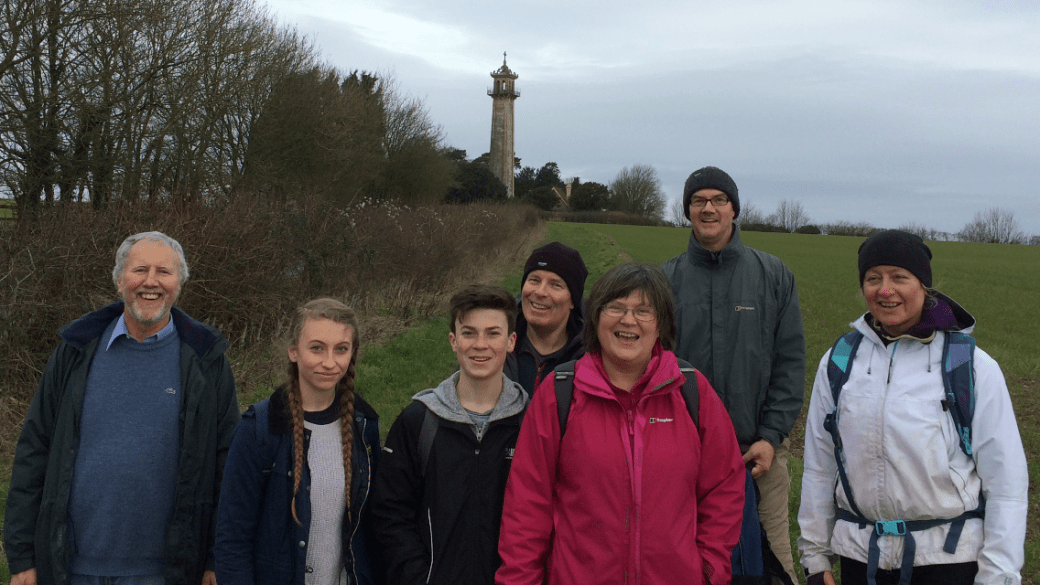

 Cromhall Chapel