So far in 1 John…

When the cares of my heart are many, your consolations cheer my soul. Psalm 94:19

Here we are, mid-way through the autumn and half-way through our study of 1 John, the letter of assurance. We have seen seven tests of assurance, yet 1 John not only provides ways in which we can discern if one is a Christian (thereby bringing assurance) but also devotional encouragements through which he seeks to build his people up in the most holy Faith (Jude 20). The Christian life is a great joy; but as we live it in a broken world filled with trials, doubts, temptations and even difficult things to which Jesus calls us to, these can seem insurmountable. We often require consolations that cheer the soul. There are few other books that surpass 1 John in the imposing demands made on the reader, along with the rich devotional rewards such study brings. To go with these challenges John also gives his readers encouragement:

  1. The joy found in responding to the Gospel (1:4);
  2. The promise of forgiveness through the confession of sin (1:9);
  3. Christ, the believer’s Advocate (2:1-2);
  4. General encouragements (2:12-14);
  5. A future hope in the New Heavens and New Earth (2:17)
  6. The gift of the Holy One (Holy Spirit) who keeps, guides and teaches Christians (2:20); and
  7. The love of the Father, through Jesus, for His children (3:1).

So if your cares happen to be many, hope on these promises, and may they be a consolation to your souls in times of many cares.

The Lord’s Sweetest Blessings,

Pastor Chris

What is compassion?

Last Sunday, we had a presentation about a Christian organization called Compassion UK which works with children in poverty in some of the poorest countries of the world. The organization’s threefold purpose is to be child focused, Christ centred and church based. Click here to find out how you can invest in the life of a child in poverty through sponsorship.

In a world that tends to use and abuse the actual meaning of words, has the true force of the definition of compassion been lost on us? Today, we might hear the word and think, “oh, how lovely, what a nice idea, compassion,” but do we really know what it means and do we demonstrate it from our hearts?

What does it mean to have compassion or be compassionate as a Christian trait and virtue?

Jesus, in Matthew 9:35-38, helpfully illustrates true compassion for us.

And Jesus went throughout all the cities and village, teaching in their synagogues and proclaiming the gospel of the kingdom and healing every disease and every affliction. When He saw the crowds, he had compassion on them, because they were harassed and helpless, like sheep without a shepherd. Then He said to His disciples, “The harvest is plentiful, but the labourers are few; therefore pray earnestly to the Lord of the harvest to send out labourers into His harvest.”

In this portion of Matthew Jesus was on a healing streak. In chapters 8 and 9 alone He has healed a man with leprosy, the centurion’s servant, Peter’s mother in Law, many more demon possessed and those who were ill. He takes a break to calm the storm, heals two more demon possessed men, a paralytic, a dead girl, another sick woman, a blind man, a man who could not speak. He continues His relentless mission of proclamation, teaching, and healing, and His renown is ever growing and the people (the crowds) are drawn to Him.

He was likely physically exhausted. Jesus could have said: “Oh these people keep bringing me their problems, can’t they just leave me alone?” or “What a bunch of helpless failures, I’m out of here.” But it says that Jesus had compassion on them (Matt 9:36).

Today we might read that word as “oh Jesus had compassion, what a good guy.” We might think of other words like sympathy or empathy. However, the Greek word for compassion is splachnizomai. It might sound funny trying to say it, but it is a profound word. It actually means a feeling from deep within, from your guts, your innards. It means to love or have concern for someone with deep pain. And such pain wells up and leads to action.

Jesus had compassion on the crowds because they were harassed and helpless (and helpless here does not mean guiltless of sin). Here were a bunch of ordinary people. They were harassed and helpless for many economic, political and spiritual reasons: Roman rule, religious oppression and their own wayward living (Jesus called them a perverse and corrupt generation). There were so many reasons why Jesus had compassion on them. But He did not pass them by, for His compassion compelled Him into action to seek to bring the life changing truths of the Gospel to bear upon their lives and life situations. Jesus too, in countless instances, commands His followers to be a people of compassion because of the compassion He show to us, by dying to save us from our sins.

Colossians 3:12, as a type of fruit of the Spirit, instructs us:

Put on then, as God’s chosen ones, holy and beloved, compassionate hearts, kindness, humility, meekness and patience…

Whether it is through supporting a child through an organization like Compassion, or something much closer to home, and perhaps very personal and messy, would we follow our Lord’s example and be a people of compassion?

The Lord’s Sweetest Blessings,

Pastor Chris

Devotion and Obedience

Last night we touched on Christian obedience in our study on 1 John.

By this we know if we have come to know Him, if we keep His commandments. (1 Jn 2:3)

Christian obedience, far from a drudge, flows out of our love for God because of who He is and what He has done, most especially in lavishing His grace upon His people and the presence of His Spirit in our life; the mark that we are a true believer. So you might say that what undergirds Christian obedience is devotion. I am currently reading another Puritan classic written by William Law in 1729. It is called A Serious Call to a Devout and Holy Life. In many ways it echoes the theme found in Wilberforce’s book Real Christianity that we studied this summer regarding nominalism and authentic Christianity. I cannot comment on the whole book because I have not finished it yet, but I was struck by the opening page in which Law unpacks the essence of true Christian devotion. I pray you’ll find it helpful. He wrote:

DEVOTION is neither private nor public prayer; but prayers, whether

private or public, are particular parts or instances of devotion.

Devotion signifies a life given, or devoted, to God.

He, therefore, is the devout man, who lives no longer to his own will,

or the way and spirit of the world, but to the sole will of God, who

considers God in everything, who serves God in everything, who makes

all the parts of his common life parts of piety, by doing everything in

the Name of God, and under such rules as are conformable to His glory.

We readily acknowledge, that God alone is to be the rule and measure of

our prayers; that in them we are to look wholly unto Him, and act

wholly for Him; that we are only to pray in such a manner, for such

things, and such ends, as are suitable to His glory.

The Lord’s Sweetest Blessings,

Pastor Chris

Suggested Readings

Over the summer I spent a lot of time reading various Puritan authors that influenced the man that I am writing a biography on for my PhD. Two such works were influential in his conversion, and also the conversion of men like Charles Spurgeon and countless others. Each work is known as a spiritual classic from its age, and I had to stop counting the insightful comments that graced their pages, each jam-packed with spiritual power and Biblical truth. As we are looking at 1 John this autumn and the topic of assurance, particularly in chapter one about a persons relationship to Jesus Christ and their understanding of sin, I thought I would recommend these two short works for the profit of Christians and non-Christians alike. For Christians it will certainly help you in your understanding of sin and God’s amazing grace. For those who are non-Christians or of the nominal sort, it will challenge you to the core as to whether you indeed have any merit to stand before the Almighty. Irregardless, the authors do not mince words! For those who take the time to read them you will be sure to be blessed (aka- don’t be put off by their 17th Century writing style, be patient).

Richard Baxter: A Call to the Unconverted

Joseph Alleine: An Alarm to the Unconverted

Enjoy!

The Lord’s Sweetest Blessings,

Pastor Chris

A disconcerting first…

A 47 year old American woman was sentenced to prison five days ago. Here crime? It wasn’t a mass shooting, or failing to pay unpaid parking fees, or neglecting a child. She was put in prison for believing that marriage is between one man and one woman (read more here). No matter what side of that debate you find yourself, this news should cause you great concern (think freedom of conscience and religious liberties). If you are a Christian who affirms God’s designs for marriage and sexuality it should cause you even greater concern. Watch out, this move signals a new trend into uncharted waters in which the Christian minority in the West, living in an increasingly anti-Christian climate, will be called to account as to where their highest allegiance lies.

While at the outset this case signals woe and concern, it is more complicated than it appears (especially because it involves American culture and politics). Firstly, there is the dynamic of the case. Kim Davis, a clerk responsible for issuing marriage licences in her local county, has refused to issue licences to both homosexual and heterosexual applicants since the Supreme Court single-handedly legalized same sex unions, citing religious beliefs as her reason. She was jailed for contempt of court because she failed to heed the judge’s demands of complying with the law and beginning to reissue licences. Such a move appears to be a larger protest with wider aims than her local county is concerned. Had she simply refused to comply in issuing a licence to a same sex couple her religious argument may have held greater sway. Still, she may have faced prison time, or perhaps more appropriately, simply been dismissed from her position (which in itself would have been sad but more just). However, as an elected official she has to be defeated in an election or impeached to lose her position. This is why her case is such a challenge to the government, because she cannot simply be dismissed and has the opportunity to become a martyr for the numerous challenges to the recent US court decision.

Her apparent willingness to suffer a losing legal battle for the sake of Christ and Christians generally, is noble, it is standing for what she believes regardless of the consequences. Jesus said, “Blessed are those who are persecuted for righteousness sake, for theirs is the kingdom of heaven” (Matt 5:10, ESV). At the time of her sentencing Davis said, “I promised to love Him [Jesus] with all my heart, mind and soul,” and she appears to have made good on that promise. Though she may lose much, including her job, she spoke of standing upon “God’s law” and not upon the ruling of the Supreme Court when it differed from Scripture. Here she is leaning upon what Jesus taught in Mark 12:17, “render to Caesar the things that are Caesar’s, and to God the things that are Gods,” and also “you cannot serve both God and money” (Mk 12:17).

In other words, you cannot serve both God and the US government, particularly when the government (on this point) is acting contrary to what you know Scripture teaches.

Thankfully today she was released from prison today, the judge hoping he had taught her a lesson. As she returns to work, which court will she be guilty of standing in contempt of, God’s or the US government?

To be sure there are many pressing issues I could have chosen to write on, one of which being the American same-sex debate. I could have also rightly highlighted the refugee crisis, the trafficking of women and children in the sex trade, or assisted dying [suicide]. All of these would be valid moral and social issues to comment upon. I suppose I chose to write upon this because when I read it I thought, given the trajectory the West has set itself upon, “this could very easily be myself [as a public Christian leader], or someone from my congregation [a Christian school teacher[1]].” This is a litmus test that could determine whether Christians in countries like the USA, Canada and England, which continue down a path of licentiousness, will simply be marginalized and ridiculed for following Christ or whether they will actually be persecuted. A jail sentence for following Jesus was a wake-up call for me.

May we pray for Kim Davis and all those Christians, especially public officials and employees, who face persecution and marginalization, that they may stand firm in their faith (1 Cor 16:13). Pray that as they stand firm they may do so in love (v.14) so that they may heap burning coals on their enemies heads (Ro 12:20). Let us pray for governments and engage with elected officials, that they may be respectful of Christian values. Let us know the facts and be biblically and intelligently informed for the battle.

For nearly 300 years Christianity has enjoyed a supremacy in the West in which persecution and marginalization was a foreign experience.

This has not always been the case, neither in English history, nor the history of the Church. May we learn from those who have gone before us and who likewise suffer for the faith around the world each day, and like the persecuted saints throughout the ages, may we be found faithful, to Christ’s honour and the Church’s witness. Amen.

Pastor Chris

[1] This will especially become the case as governments and school boards make it mandatory for teachers and staff to promote immoral curriculum which will be against a Christian’s belief.

Resources from Sunday

Praise the Lord for a great day of teaching and fellowship at the chapel! In the morning we looked at a robust basis for true unity amongst the churches. In the afternoon we had pleasant weather for our Tortworth Lake walk and tea and were blessed to have Rev. Maurice Wheatley with us in the evening when he spoke on providence. It was great to have so many family members and guests along with us too!

Further to the our sermon from Amos 3:3 (“How can two walk together unless they are agreed”) here are a couple helpful articles if you would like to pursue the topic further.

Our FIEC Gospel Unity Statement can be found here.

On the subject of theological triage you can find a helpful article by Albert Mohler Jr. here.

Another helpful model comes from the ESV Study Bible (2008), pp. 2506-07. I summarize it here. Similar to the model of theological triage is one of a target, or concentric circles. We are to aim to hit the mark in the middle, not straying from orthodox belief. That said we must recognize that not all doctrines have the same significance and affect how we relate to others who profess to be a believer or who truly are.  We need to ask ourselves the question, “on which hill are we willing to die.” Let us not confuse the periphery for the centre.

concentric circles

The relative importance of theological issues can fall within four categories: absolutes or the core beliefs of Christianity, convictions or those beliefs which are so important have a significant impact of the health and effectiveness of the Church, opinions or items that are less clear and certainly not worth dividing over, and questions or unsettled items to which answers would not necessarily effect or alter the absolute tenants of the Faith.

To help one discern where a theological or practical issues falls within the circle one can weigh the cumulative force of the following seven considerations: 1) relevance to the character of God; 2) biblical clarity; 3) relevance to the essence of the gospel; 4) biblical frequency and significance; 5) effects on other doctrines; 6) consensus among Christians; and 7) effect on personal and Church life. These need to be understood collectively. Often only one of these seven tools is used which produces a skewed result and a person or tribe resting upon an absolute that is actually an opinion (or visa versa). “The ability to rightly discern the difference between core doctrines and legitimately disputable matters will keep the Church from either compromising important truth or needlessly dividing over peripheral issues.”

The Lord’s Sweetest Blessings,

Pastor Chris

Faulty Thinking

This summer we have been blessed by our mid-week studies on William Wilberforce’s book Real Christianity (modern paraphrase version, 2006). The book seeks to contrast the differences between authentic Christianity or nominal and cultural Christianity to a) help believer’s better understand their faith and share it with others and b) show nominal Christians the faulty thinking behind their own claims and so lead them to Christ. Some areas of such faulty thinking we have investigated surrounds works vs. grace righteousness, the fallen nature of humanity, the presence of evil, and human vs. divine wisdom and authority. At its heart each of these topics comes back to how we view Scripture. Proverbs 3:5-8 says:

Trust in the Lord with all your heart,
    and do not lean on your own understanding.
In all your ways acknowledge him,
    and he will make straight your paths.
Be not wise in your own eyes;
    fear the Lord, and turn away from evil.
It will be healing to your flesh
    and refreshment to your bones.

While nominal Christianity still proves a issue, a matter we have often discussed that is both associated with it but different from it is modernist or liberal Protestantism. On this matter this chasm could not be wider between the option of truth and falsehood. Which will you choose? In only one will you find life and life to the full (Jn 10:10):

chasm[image from an unknown American newspaper circa. 1920s]

Chapel Upgrades

20150720_135106[1] 20150720_151503 20150720_144954

Thus says the LORD of hosts: Consider your ways. Go up to the hills and bring wood and build the house, that I may take pleasure in it and that I may be glorified, says the LORD. You looked for much, and behold, it came to little. And when you brought it home, I blew it away. Why? Declares the LORD of hosts. Because of my house that lies in ruins, while each of you busies himself with his own house. (Haggai 1:7-9 ESV)

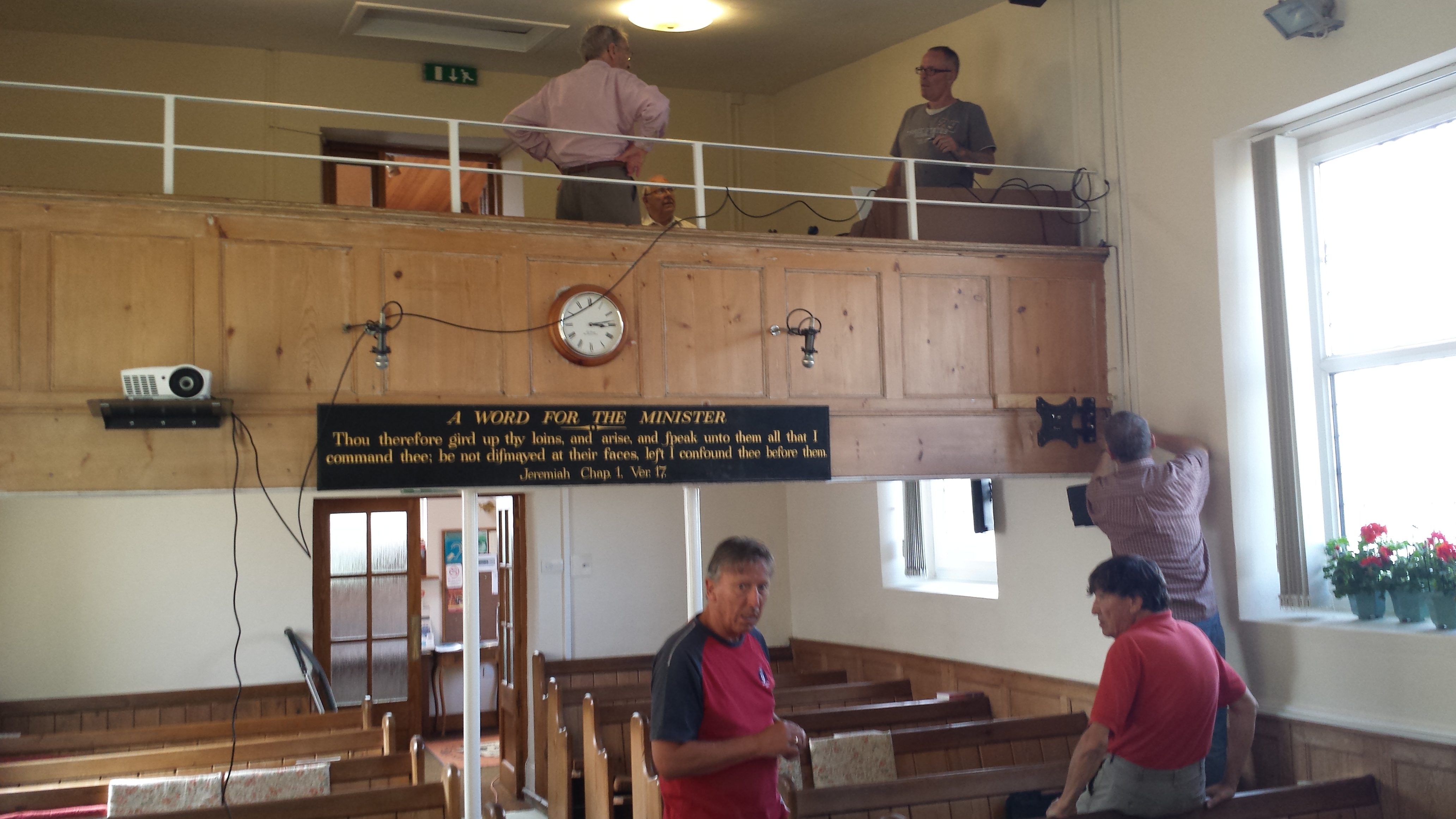
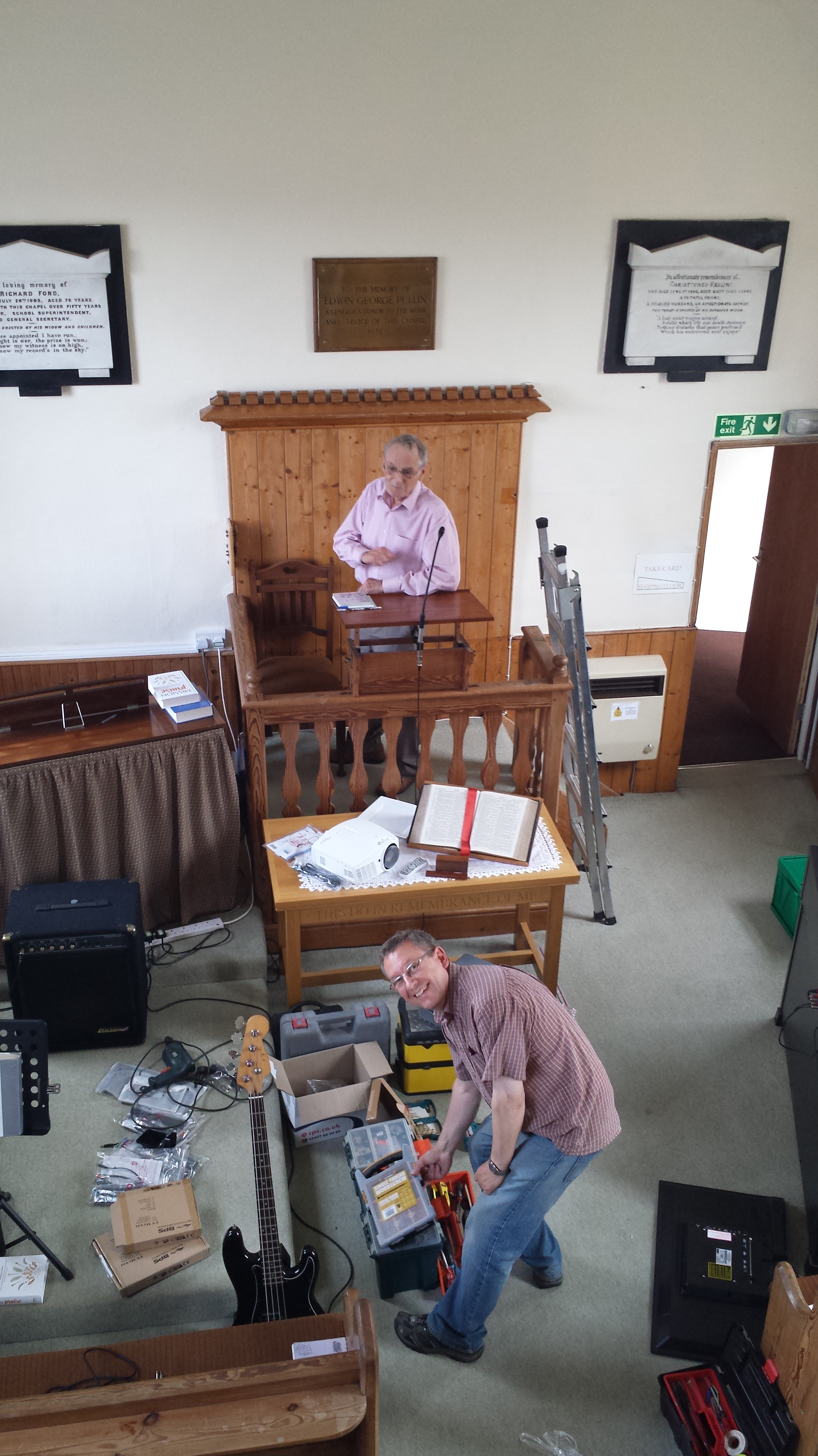
This afternoon a number of men from the chapel came out for a work-bee to install phase I of our chapel upgrades this summer (thanks guys!). These included audio-visual upgrades (a new lap-top, projector, monitors and sound upgrades) and phase II will be the replacement of historic plaques at the front of the chapel to the rear to make space for the projector to project upon, as well as the placement of a cross.

As a local Christian fellowship we believe that the meeting house, chapel, church or whatever one calls the physical place where worship and ministry centre around, is not the Church but merely facilitates its life. The Church is the community of the redeemed in Christ both local and universal. The chapel building, like our new audio-visual upgrades, is only a tool to facilitate local ministry. We are grateful for this building entrusted to us and seek to maintain it in such a way as to glorify God. Bearing in mind that our chapel is not “the Temple” and what has been said above, we desire to ensure our chapel is ship shape and Bristol fashion for the following reasons:

  1. So passersby’s or visitors will see the glory of God because this buildings is cared for in such a way as to magnify the Lord and be useful for His service;
  2. So people will know that our God is not a shoddy God but worthy of our physical and spiritual sacrifices of worship (*I recognize poor chapels cannot always do this and so while important does not necessarily represent the heart of a church. Likewise a church may be quite ornate and the hearts of its people empty); and
  3. So that the chapel itself may serve as a help and not a hindrance as worshippers seek to behold the glory of God in worship, be built up in the faith and respond in service.

We desire to make the Lord and his chapel, but much more importantly, His Gospel, His ways and His mission the prime priority in our lives, lest while our houses may be decked to the nines, the Lord’s work suffers neglect.

The Lord’s Sweetest Blessings,

Pastor Chris

Sunday Sermon Follow-up

Last evening at chapel we worked through 1 Cor 6:9-11 in response to a Summer People’s Choice Sermon question on homosexuality. Click here to listen to that sermon from July 19 P.M.

There is a lot of good literature that has been produced on this subject from a Christian perspective (and lots of junk so beware!). American pastor John Piper wrote this short article on his blog on June 27, the day the US Supreme Court legalized same-sex marriages in all 50 states. I am re-blogging it here and hope that it will continue the conversation begun last night towards further discussion of a topic that we will continue to have to deal with into the future.

“Fixing” the Church with Square Wheels

dontreinventthemap-6ba62b8ba05d4957d2ed772584d7e4cdI have just spent the last several days at an international Baptist history conference on the subject of Baptists and revival. It was great connecting with scholars from around the world. While I do not personally like employing these terms, for lack of a better term or explanation, there was a wide range of scholars holding anywhere from ultra-liberal to conservative evangelical views.

At one of our meal times the questions turned to the state of life of the church in our home regions. New Zealand, Australia, Canada and the UK were all represented at the table. One individual had not liked some of the statistics I had revealed and language I had used about Christianity in Canada, and rightly said that they probably did not capture all of the “fresh expressions” of church. She went on to spell off new creative initiatives, folks who wanted to embrace new cultural norms such as homosexuality, and then frustratingly aired her bewilderment at why “conservative” churches were growing while many of these “fresh expressions” were not. She did not entirely appreciate my answer, though I pray my genuine and gentle response gave her something to think about, however, another chap at the table was very interested in what I had to say. I was grateful that I was at least able to encourage his already existent views.

The first individual thought that the answer to rescuing the state of the church in the West was to reinvent it. Certainly I would agree we need to engage different and developing cultures with the Gospel in different ways. She was trying to reinvent the wheel but trying square wheels, triangular wheels, oval wheels, and even no wheels, in a desperate attempt to sort things out. She was greatly troubled as to why those churches who were continuing with round wheels seemed on the whole to be growing.

The faulty thinking in her reasoning was this. She felt that the “round wheel” was obviously antiquated and was reacting against this to find out what would work. I would contend that she didn’t know what the true round wheel was in the first placed and asked her, “tell me about this round wheel you are reacting against because I probably don’t believe in it either.” Both she and her church were reacting against the failure of nominal and liberal christianity falsely believing it had been the real thing. As a result their church was floundering.

As the Church we do not need to reinvent “church” but only rediscover it, or in other words get an alignment.

We already know what works and that is the Truth. A dependence upon God through prayer and His word, and a belief in orthodox Christianity is the only thing that produces fruit. As a friend of mine often says, “we need to get the Gospel right and we need to get the Gospel out!”

“And the word of God continued to increase, and the number of the disciples multiplied greatly in Jerusalem, and a great many of the priests became obedient to the faith.” (Acts 6:7 ESV).

The Lord’s Sweetest Blessings,

Pastor Chris